
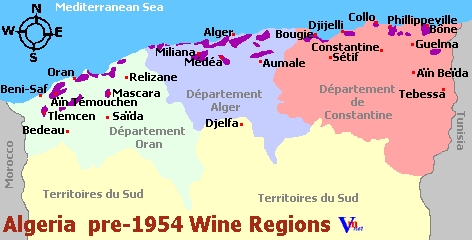
Algeria is located in North Africa along the Mediterranean coast and has a long history of wine production dating back to Phoenician and Roman times. During the 19th and early 20th centuries, Algeria was one of the largest wine producers in the world, supplying significant quantities of wine to Europe, particularly France.
The country's wine regions are primarily concentrated along the northern coastal belt, where Mediterranean climatic conditions provide suitable environments for viticulture. Inland areas quickly transition to arid and desert conditions, limiting vineyard expansion.
Modern wine production in Algeria is much smaller than in its historical peak, but vineyards still exist and produce both red and white wines. The industry continues on a limited scale with a focus on traditional wine-growing areas.
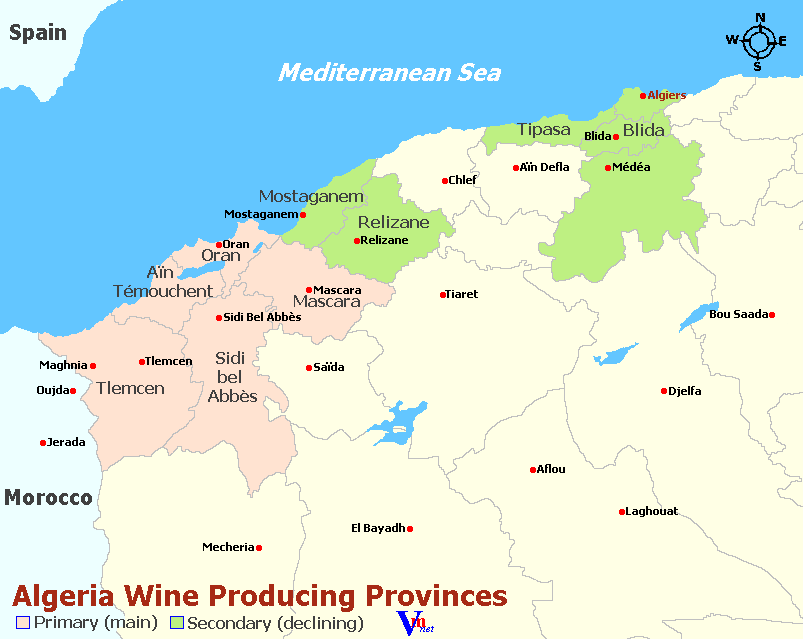
This is where almost all current wine production occurs.
Primary wine-producing wilayas:
Oran
Mascara
Ain Temouchent
Sidi Bel Abbes
Tlemcen
Secondary / smaller areas:
Relizane
Mostaganem
This region has the strongest Mediterranean climate and remains the core of Algeria's wine industry.
Historically important, now reduced but still present.
Wine-related wilayas:
Blida (Mitidja Plain - key agricultural area)
Tipaza
Algiers
Medea
Production here is mostly small-scale compared to the west.
During the French colonial period, Algeria operated under an Appellation d'Origine Controlee (AOC) system similar to that used in France. These appellations defined specific wine-growing areas and production standards. The system was discontinued after independence in 1962.
Notable historical AOC areas included:
Coteaux de Mascara
Monts du Tessalah
Dahra
Medea
These names are still referenced in historical wine literature but are no longer used in modern Algerian wine classification.
Algerian vineyards have traditionally grown a mix of Mediterranean grape varieties.
CarignanModern production focuses on smaller quantities of regional wines, often reflecting traditional styles.
Algeria is a historically significant wine-producing country that once played a major role in global wine supply. Although production has declined, its Mediterranean climate and long-established vineyard regions continue to support a smaller but notable wine industry.