
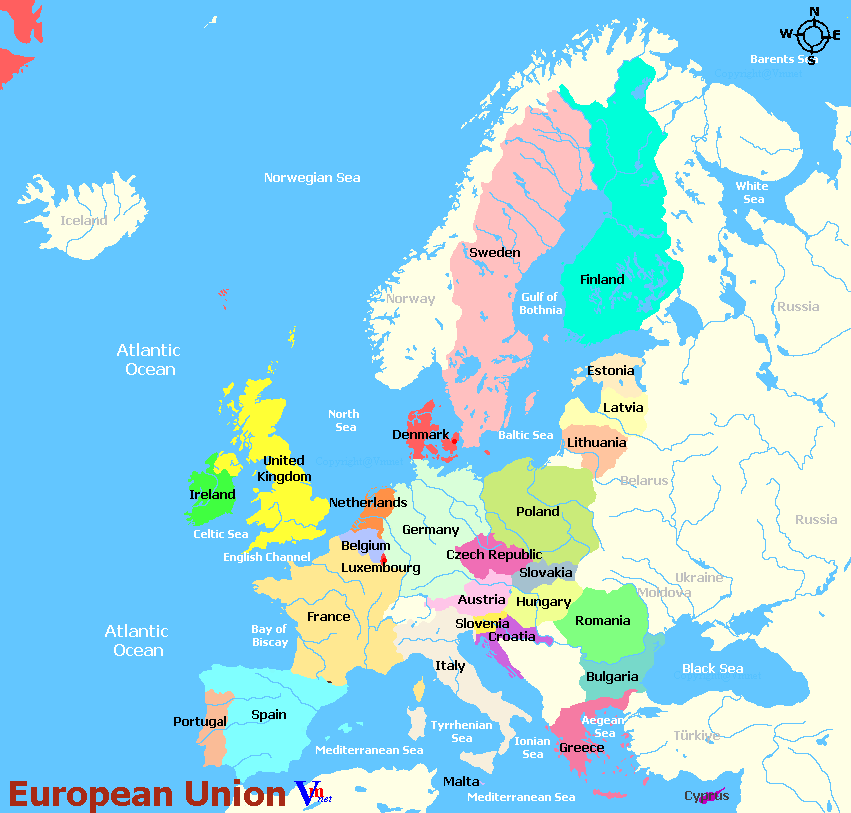
The European Union (EU) is a political and economic union of member states across Europe and represents the largest wine-producing bloc in the world. Major wine-producing countries within the EU include France, Italy, Spain, Germany, Portugal, Greece, Austria, Hungary, Romania, Bulgaria, Croatia, and others. Together, EU member states account for a significant share of global wine production, exports, and consumption.
Wine regulation within the EU is governed by a common agricultural framework that standardizes labeling, origin protection, production rules, and quality classifications. The two primary geographical classifications are PDO (Protected Designation of Origin) and PGI (Protected Geographical Indication). PDO wines must originate entirely from a defined area and follow strict production rules tied to tradition and terroir. PGI wines allow greater flexibility while maintaining a defined geographic link.
Wines that do not qualify under these systems may be labeled without geographical indication. The EU system protects thousands of recognized wine regions, from Bordeaux and Rioja to Tokaj, Douro, and Mosel. Regulations cover grape varieties, yield limits, alcohol levels, production methods, and labeling requirements. This framework ensures consistency across member states while preserving regional identity.
In addition to still wines, the EU produces significant quantities of sparkling, fortified, and sweet wines under protected names such as Champagne, Prosecco, Cava, Port, and Sherry. The EU wine sector plays a major economic role, supporting rural employment, export markets, and cultural heritage across the continent.
| EU Links: |
| Lists - wine sector |
| Register of designations of origin and geographical indications protected in the EU |
| LIST OF TRADITIONAL TERMS |
| Sources used |
| Europe |
| EUR-Lex |
| E-Bacchus |