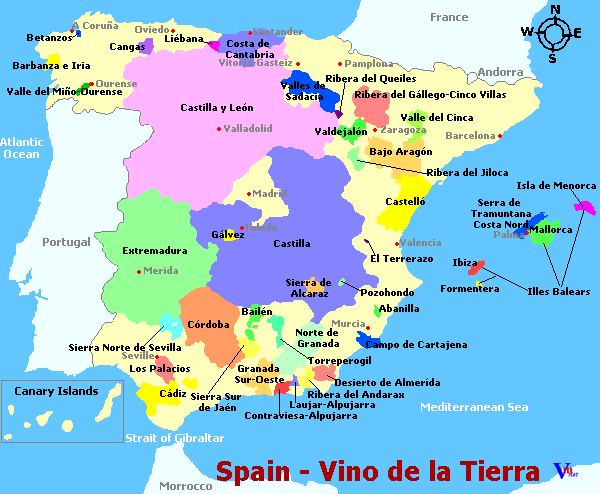
Position in the Spanish Wine Classification System
Spanish wines are generally classified in the following hierarchy:
- DOCa / DOQ (Denominacion de Origen Calificada) - highest quality designation
- DO (Denominacion de Origen) - regulated wine regions
- Vino de Pago - single estate designation
- IGP / Vino de la Tierra - protected geographic indication
- Vino - table wine without geographic designation
IGP wines therefore occupy an intermediate level between regulated appellations and basic table wines.
Characteristics of IGP Wines
IGP wines allow greater flexibility in production compared with DO wines.
Typical features include:
- Wider range of permitted grape varieties
- More flexible blending rules
- Larger geographic areas
- Freedom to experiment with international grapes and modern styles
Because of this flexibility, many innovative Spanish wines are produced under the IGP category.
Examples of Spanish IGP Regions
Spain contains numerous Vino de la Tierra / IGP regions. Examples include:
- Castilla
- Extremadura
- Cadiz
- Mallorca
- Murcia
- Valle del Cinca
- Ribera del Queiles
These regions identify the origin of the wine while allowing winemakers broader freedom than in stricter
appellation systems.
Role in Modern Spanish Winemaking
IGP wines have become an important part of Spain's modern wine industry. Many producers use the
category to create varietal wines or blends that fall outside the traditional rules of DO appellations. As a
result, the IGP classification has contributed to innovation and experimentation while still maintaining
geographic identity.