
Germany is one of the world's leading cool-climate wine-producing countries, known for its high-quality white wines and strong regional identity. Viticulture in Germany dates back to Roman times and is concentrated primarily in the western and southern parts of the country along major river systems.
German wine regions are defined by climate, soil, and geography, with vineyards often located on steep slopes along rivers such as the Rhine, Mosel, and Main. These locations help maximize sunlight exposure and retain heat in cooler growing conditions.
Germany is internationally recognized for its Riesling wines, although a wide range of grape varieties and wine styles are produced across its regions.
Germany uses a classification system based on both origin and grape ripeness at harvest.
PDO (Protected Designation of Origin)
German PDO wines are classified as Qualitätswein (quality wine) and Prädikatswein, with strict rules governing origin and production.
Prädikatswein Categories
These include Kabinett, Spätlese, Auslese, Beerenauslese, Trockenbeerenauslese, and Eiswein, which indicate levels of grape ripeness and style.
PGI (Protected Geographical Indication)
Known as Landwein, these wines have broader geographic designations and fewer restrictions.
Deutscher Wein
Basic table wine category with minimal geographic requirements.
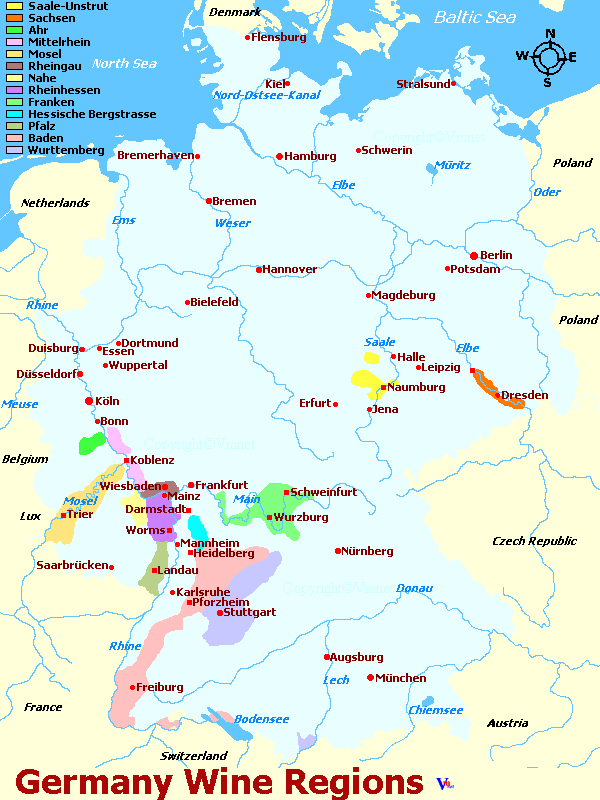
Germany has 13 official wine regions:
A small northern region known for red wines, particularly Pinot Noir.
Located in southwestern Germany, Baden is one of the warmest regions and produces a wide range of wines.
Known for Silvaner wines and distinctive bottle shapes (Bocksbeutel).
A small region south of Frankfurt with mixed wine styles.
A narrow region along the Rhine River known for steep vineyards and Riesling wines.
One of Germany's most famous regions, producing high-acidity Riesling wines from steep slate vineyards.
A diverse region producing both white and red wines with varied soil types.
A warm region known for both Riesling and red wines, including Dornfelder and Pinot Noir.
A historic wine region along the Rhine, known for high-quality Riesling and Spätburgunder (Pinot Noir).
Germany's largest wine region, producing a wide range of styles.
The northernmost wine region in Germany, with cool-climate conditions.
A small eastern region near Dresden with limited production.
A region known for red wines, particularly Trollinger and Lemberger.
Germany is best known for white grape varieties.
Key white grapes:
Key red grapes:
Spätburgunder (Pinot Noir)
Dornfelder
Trollinger
Lemberger
Germany produces a wide range of wine styles:
dry white wines
off-dry and semi-sweet wines
sweet and dessert wines
light to medium-bodied red wines
sparkling wines (Sekt)
German viticulture is influenced by:
cool continental climate
river valley microclimates
steep vineyard slopes
heat-retaining soils such as slate
These conditions contribute to wines with high acidity and strong varietal character.
Germany is a major cool-climate wine-producing country with 13 official wine regions. Its focus on Riesling and structured classification system make it one of the most distinctive and influential wine producers in the world.