
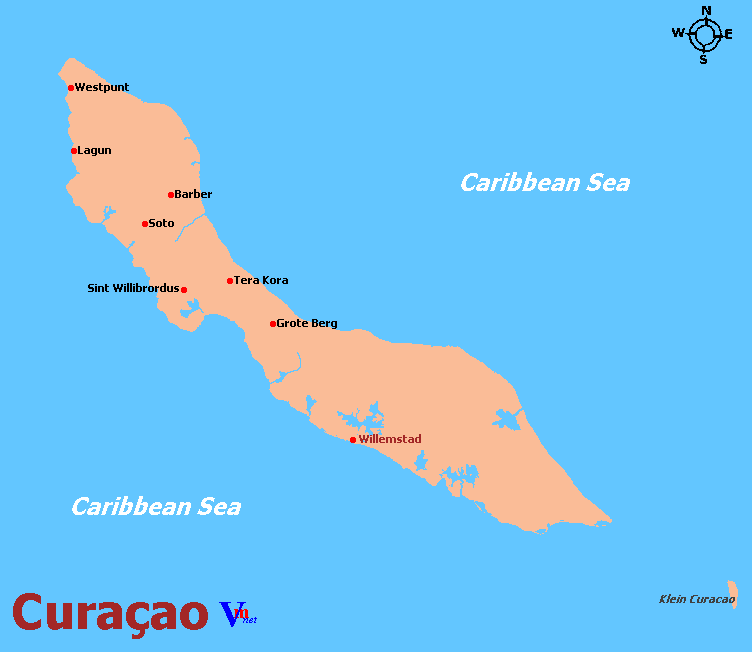
Curacao is a Caribbean island located just north of Venezuela and is part of the Kingdom of the Netherlands. Throughout its history, the island has served as an important trading centre linking Europe, the Americas, and the Caribbean.
Unlike traditional wine-producing regions, Curacao has a dry climate and limited agricultural land. Commercial vineyards are virtually nonexistent, and nearly all wines consumed on the island are imported.
Rather than wine production, Curacao is famous worldwide for a unique citrus liqueur that carries the islands name.
Curacao's most famous alcoholic product is its orange-flavoured liqueur.
Blue Curacao
Perhaps the best-known Caribbean liqueur in the world. Although often coloured bright blue, the original
liqueur is naturally clear. It is flavoured using the dried peels of the Laraha citrus fruit that grows on
Curacao.
Laraha Citrus
The Laraha developed from Valencia oranges brought to the island by Spanish settlers. Over time, the
fruit adapted to Curacao's dry conditions and became too bitter to eat, but its aromatic peels proved ideal
for producing liqueurs.
Today, Curacao liqueurs are produced in several colours, including blue, orange, green, and clear versions.
The islands beverage culture combines Dutch, Caribbean, Latin American, and maritime influences.
Curacao Cocktails
Many tropical cocktails use Curacao liqueur as a key ingredient because of its distinctive citrus flavour
and bright colour.
Rum-Based Drinks
Rum remains widely consumed throughout the island and is commonly mixed with tropical juices and
local ingredients.
Ponche Crema
A creamy holiday beverage found throughout parts of the Dutch Caribbean, often enjoyed during festive
occasions.
Wine is widely available in Curacao's restaurants, resorts, and hotels, serving both residents and international visitors.
Common wine imports come from:
FranceDutch and European trade connections have historically influenced the islands wine imports and beverage choices.
Curacao differs from many tropical Caribbean islands because it has a relatively dry climate.
semi-arid conditionsThese conditions support the growth of the Laraha citrus but are generally unsuitable for large-scale vineyard development.
The islands location along important shipping routes made it a centre for commerce and cultural exchange. Dutch, Spanish, Portuguese, African, and Caribbean influences all contributed to the development of Curacao's distinctive food and beverage traditions.
The worldwide success of Curacao liqueur remains one of the most visible examples of the islands influence on international beverage culture.
Curacao is not a wine-producing island, but it has achieved global recognition through the production of Curacao liqueur made from the islands unique Laraha citrus fruit. Imported wines, rum-based drinks, and citrus liqueurs form the foundation of a beverage culture that is unlike any other in the Caribbean.