
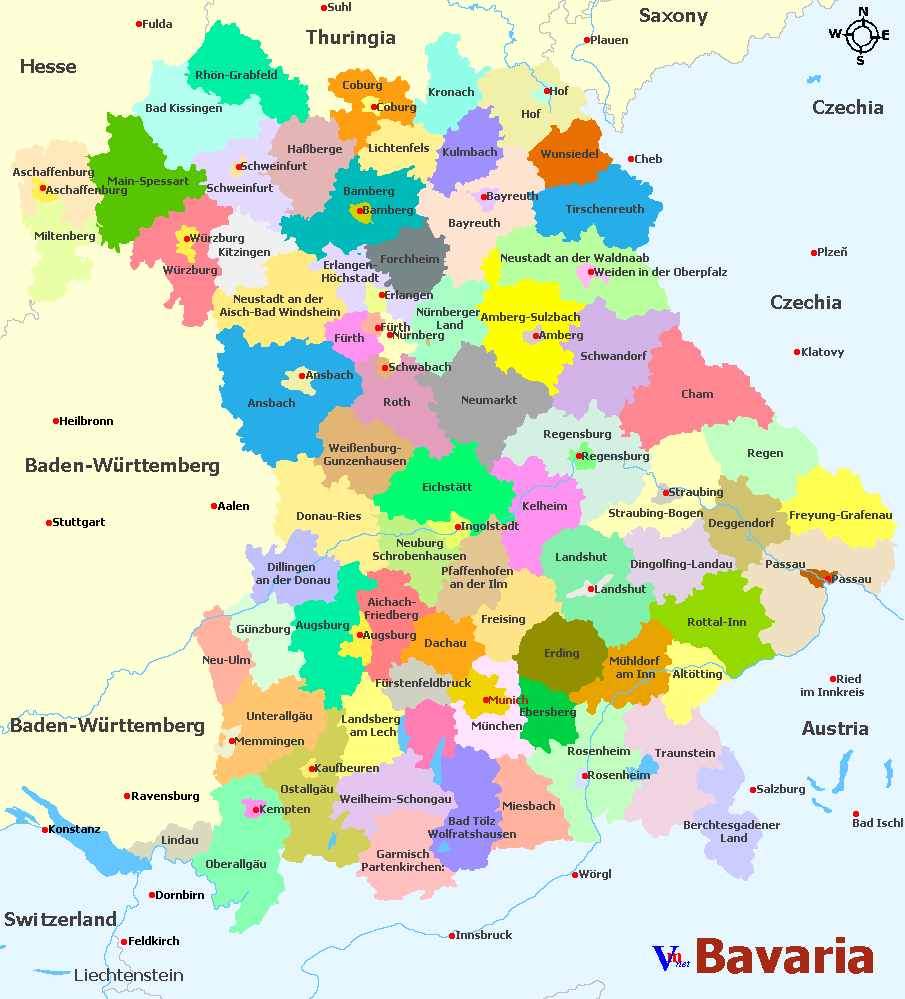
Bavaria (Bayern) is a large federal state in southern Germany. While most of Bavaria is not suitable for viticulture due to its alpine and continental climate, a small but important wine-producing area exists in the northern part of the state.
Wine production in Bavaria is concentrated almost entirely within the Franconia (Franken) wine region, which is one of Germany's 13 official wine regions (Anbaugebiete).
Franconia is the primary wine-producing region in Bavaria, located in the northern part of the state along the Main River. The region is known for its dry white wines and distinctive bottle shape known as the Bocksbeutel.
Key areas:
Würzburg
Kitzingen
Schweinfurt
Volkach
Vineyards are typically found on slopes along the Main River, where conditions are more favorable for grape growing.
Franconia follows Germany's national wine classification system, including PDO (Qualitätswein and Prädikatswein) and PGI (Landwein).
The region is best known for white grape varieties.
Key white grapes:
Silvaner
Müller-Thurgau
Bacchus
Riesling
Key red grapes:
Spätburgunder (Pinot Noir)
Domina
Franconia is known for:
dry white wines
mineral-driven wines
structured and food-friendly styles
Silvaner is the signature grape of the region and produces some of Germany's most distinctive dry wines.
Viticulture in Bavaria is influenced by:
continental climate
river valley microclimates along the Main River
limestone and shell limestone soils (Muschelkalk)
moderate rainfall and warm summers
These conditions allow grape growing in an otherwise cool region.
Bavaria is not a major wine-producing state overall, but the Franconia region provides a well-defined and historically important wine area. Its focus on dry white wines and traditional styles makes it a distinctive part of Germany's wine landscape.