
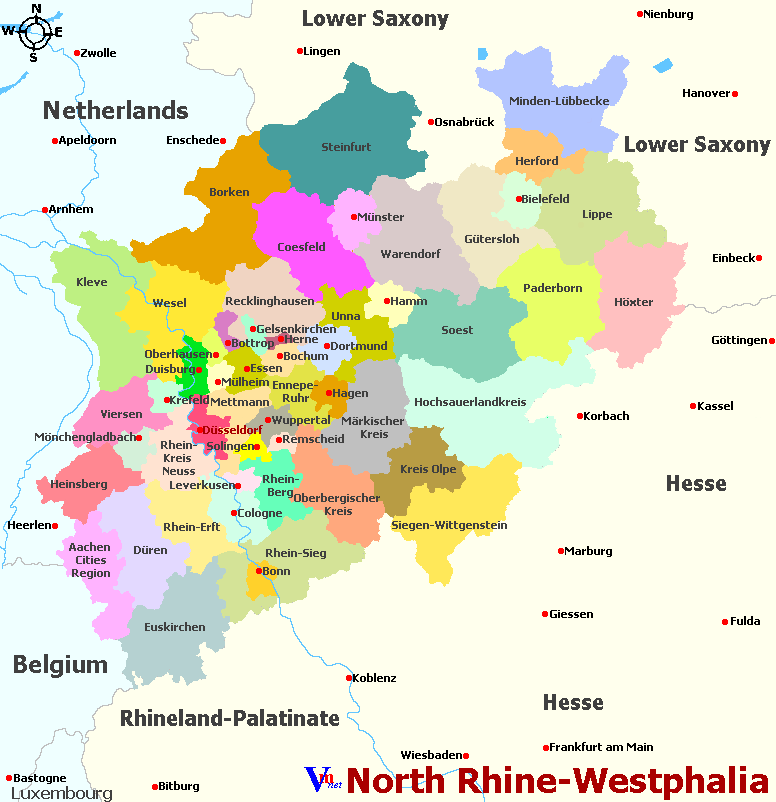
North Rhine-Westphalia (Nordrhein-Westfalen) is a federal state in western Germany and is not a major wine-producing region. However, a small portion of the state forms part of the Mittelrhein wine region, one of Germany's 13 official wine regions (Anbaugebiete).
Viticulture in North Rhine-Westphalia is limited and concentrated along the Rhine River in the southern part of the state. The river creates a favorable microclimate that allows grape growing in an otherwise cool environment.
The Mittelrhein wine region follows the Rhine River between Bingen and Bonn. The northern section of this region lies within North Rhine-Westphalia.
Key areas:
Bonn
Königswinter
Bad Honnef
Vineyards are typically planted on steep slopes along the river, helping maximize sunlight exposure and heat retention.
North Rhine-Westphalia follows Germany's national wine classification system through the Mittelrhein region, including PDO (Qualitätswein and Prädikatswein) and PGI (Landwein).
The region produces mainly white wines.
Key white grapes:
Riesling
Müller-Thurgau
Weissburgunder (Pinot Blanc)
Key red grapes:
Spätburgunder (Pinot Noir)
The Mittelrhein area is known for:
light and fresh white wines
high-acidity Riesling wines
mineral-driven styles
small-scale production wines
Viticulture in North Rhine-Westphalia is influenced by:
cool continental climate
Rhine River microclimate
steep vineyard slopes
limited vineyard area
These conditions restrict production but allow high-quality wines in suitable locations.
North Rhine-Westphalia is not a major wine-producing state, but a small portion contributes to the Mittelrhein wine region. Vineyards along the Rhine produce primarily Riesling and other cool-climate wines in limited quantities.