
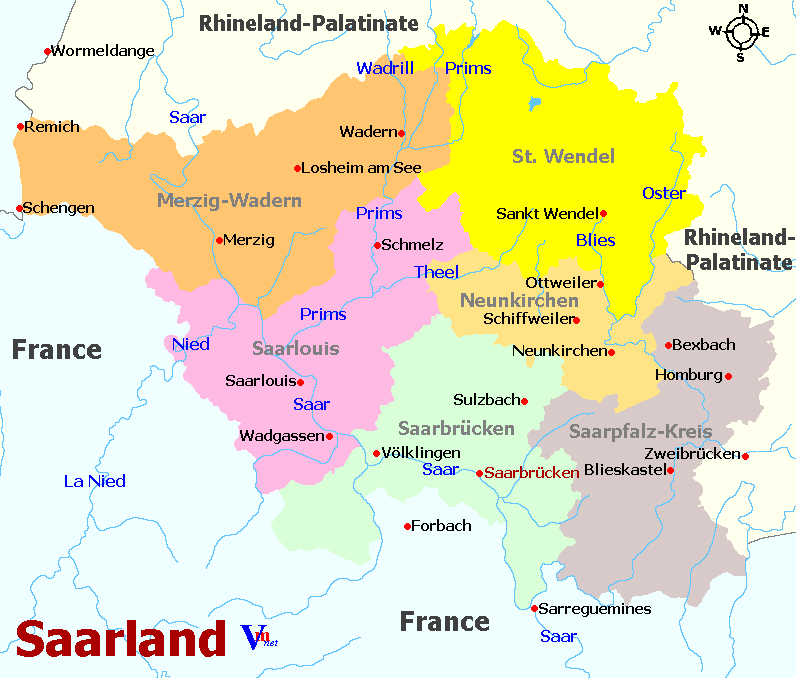
Saarland is a small federal state in southwestern Germany and is not an independent wine region. Instead, it forms part of the Mosel wine region, specifically the Saar sub-region, which is one of the most respected areas for Riesling production.
Viticulture in Saarland is concentrated along the Saar River near the border with Luxembourg. The combination of river influence, steep slopes, and slate soils creates favorable microclimates in an otherwise cool climate.
The Saar sub-region is part of the Mosel wine region (Mosel, Saar, and Ruwer) and is known for producing elegant and high-acidity Riesling wines. These wines are often lighter in alcohol and can range from dry to very sweet styles.
Key areas:
Saarburg
Perl
Nennig
Vineyards are typically located on steep slopes along the Saar River, where slate soils help retain heat and support grape ripening.
Saarland follows Germany's national wine classification system through the Mosel region, including PDO (Qualitätswein and Prädikatswein) and PGI (Landwein).
The Saar area is dominated by white grape varieties.
Key grapes:
Riesling (primary variety)
Müller-Thurgau (limited plantings)
The Saar sub-region is known for:
high-acidity Riesling wines
light and elegant wines
off-dry and sweet styles
age-worthy wines with mineral character
Viticulture in Saarland is influenced by:
cool continental climate
Saar River microclimate
steep vineyard slopes
slate soils that retain heat
These conditions allow high-quality wine production despite limited vineyard area.
Saarland is not a standalone wine region but forms part of the Mosel wine region through the Saar sub- region. Its vineyards produce some of Germany's most refined Riesling wines in a cool-climate environment.