
The Sonoita AVA is located in southeastern Arizona and was designated as an American Viticultural Area (AVA) on October 25, 1984, making it Arizona's first federally recognized wine region. The AVA covers approximately 208,000 acres (84,175 hectares), or about 325 square miles (842 square kilometres), extending across portions of Santa Cruz, Cochise, and Pima counties. Although only a small percentage of the appellation is planted with vineyards, its large size provides numerous favourable vineyard sites with varying elevations, soils, and microclimates.
The region is centred around the communities of Sonoita and Elgin. Its relatively high elevation, rolling grasslands, and surrounding mountain ranges create conditions well suited to viticulture despite Arizona's generally arid climate. Numerous boutique wineries and family-owned vineyards operate throughout the AVA.
Today, the Sonoita AVA is recognized as one of the leading wine-producing areas in the southwestern United States and has played a major role in the development of Arizona's modern wine industry.
Wine production is concentrated throughout the Sonoita AVA and nearby communities.
Sonoita - The centre of the AVA with numerous vineyards and wineries.
Elgin - Arizona's best-known wine village and home to several tasting rooms and
vineyards.
Patagonia - Small vineyard developments located south of the main AVA.
Canelo Hills - High-elevation vineyard sites with favourable growing conditions.
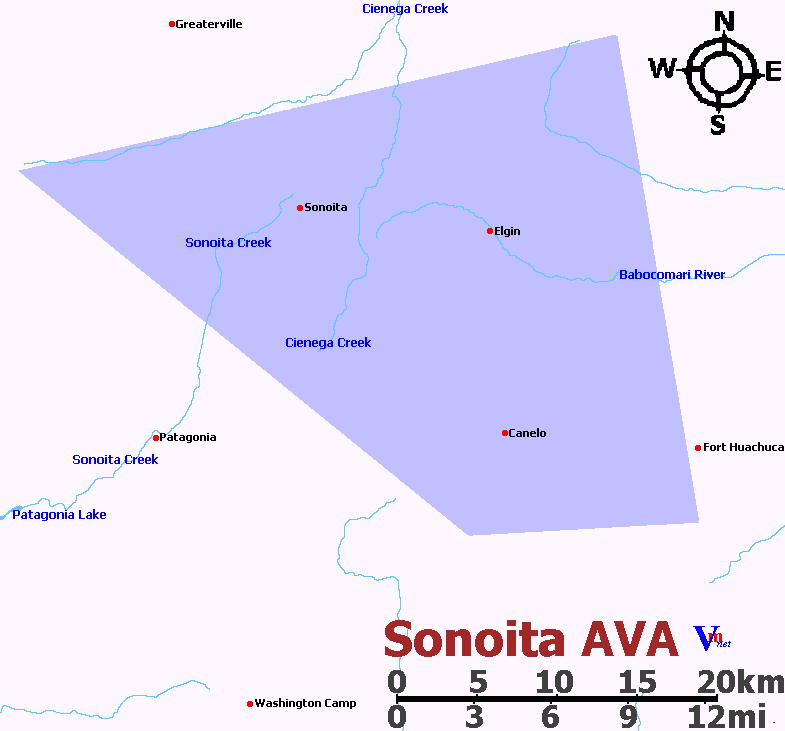
The Sonoita AVA produces a wide range of premium wines including:
Cabernet Sauvignon
Cabernet Franc
Merlot
Syrah
Grenache
Mourvedre
Tempranillo
Sangiovese
Malbec
Petite Sirah
Tannat
Viognier
Chardonnay
Sauvignon Blanc
Riesling
Albarino
Vermentino
Rose wines
Red blends
White blends
Viticulture within the Sonoita AVA is influenced by:
High elevations ranging from approximately 4,500 to 5,200 feet (1,370 to 1,585 metres)
Warm sunny days during the growing season
Cool nights that help preserve acidity and flavour development
Large day-to-night temperature variation
Semi-arid climate with summer monsoon rainfall
Approximately 200-day growing season
Rolling grasslands surrounded by the Santa Rita, Huachuca, Whetstone, and Mustang mountain
ranges
Well-drained gravelly loam, sandy, limestone-derived, and alluvial soils
The combination of elevation, moderate temperatures, and well-drained soils provides an environment that supports the production of balanced, high-quality wines. :contentReference[oaicite:1]{index=1}
The Sonoita AVA contains numerous commercial vineyards and boutique wineries. Most vineyards are relatively small, with many producing estate-grown wines. Winemakers focus on varieties that perform well in warm climates while benefiting from the region's cool nights, low humidity, and extended growing season.
Sustainable vineyard practices are increasingly common, and many wineries produce limited-production premium wines sold primarily through cellar doors and regional distribution.
The Sonoita AVA is Arizona's oldest federally recognized wine region and remains the centre of the state's wine industry. Covering approximately 208,000 acres (84,175 hectares), the appellation combines high elevations, mountain-influenced climate, well-drained soils, and an expanding collection of boutique wineries to produce distinctive wines that have established the region as one of the premier wine- producing areas in the American Southwest.