
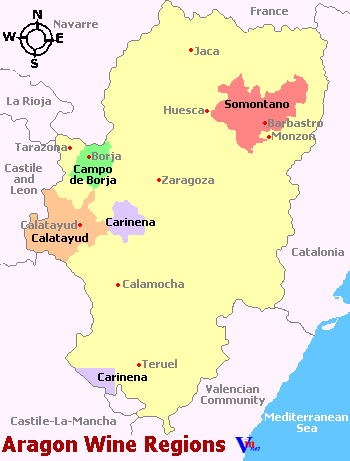
Aragón is located in northeastern Spain between Catalonia, Navarra, Castilla y León, and Valencia. The region stretches from the foothills of the Pyrenees in the north to the dry interior valleys of the Ebro River basin. Viticulture in Aragón has ancient roots dating back to Roman times, and the region has historically played an important role in Spanish wine production.
The climate is mostly continental with Mediterranean influences, characterized by hot summers, cold winters, and low rainfall. Strong winds known as the Cierzo blow through the Ebro Valley and help keep vineyards dry and healthy. Many vineyards are planted on rocky or limestone soils that provide good drainage and contribute to concentrated grape flavors.
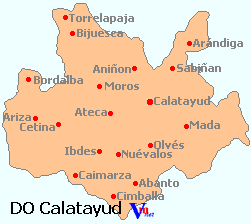 Situated west of Zaragoza in a mountainous landscape. Vineyards are planted at higher elevations,
producing structured and mineral-driven wines, particularly from old-vine Garnacha.
Situated west of Zaragoza in a mountainous landscape. Vineyards are planted at higher elevations,
producing structured and mineral-driven wines, particularly from old-vine Garnacha.
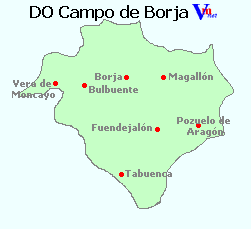 Located northwest of Zaragoza near the slopes of the Moncayo Mountains. Campo de Borja is
internationally known for high-quality Garnacha wines and is often referred to as the "Empire of
Garnacha."
Located northwest of Zaragoza near the slopes of the Moncayo Mountains. Campo de Borja is
internationally known for high-quality Garnacha wines and is often referred to as the "Empire of
Garnacha."
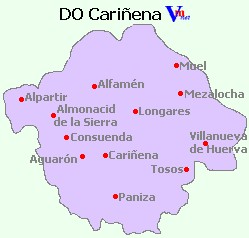 One of Spain's oldest regulated wine regions. The vineyards lie south of Zaragoza in the Ebro Valley. The
region is well known for Garnacha and Cariñena (Carignan) grapes and produces both traditional and
modern red wines.
One of Spain's oldest regulated wine regions. The vineyards lie south of Zaragoza in the Ebro Valley. The
region is well known for Garnacha and Cariñena (Carignan) grapes and produces both traditional and
modern red wines.
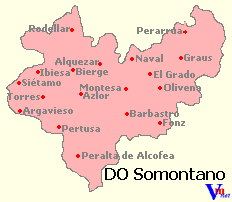 Located in the foothills of the Pyrenees in northern Aragón. The cooler climate allows a wide range of
grape varieties, including international grapes such as Cabernet Sauvignon, Merlot, Chardonnay, and
Gewürztraminer.
Located in the foothills of the Pyrenees in northern Aragón. The cooler climate allows a wide range of
grape varieties, including international grapes such as Cabernet Sauvignon, Merlot, Chardonnay, and
Gewürztraminer.
Aragón produces a variety of wine styles ranging from powerful red wines made from old-vine Garnacha to fresh whites and rosés. Higher-altitude vineyards in Somontano and Calatayud often produce wines with good acidity and structure, while lower valley vineyards produce fuller-bodied Mediterranean styles.
The region has become increasingly recognized for old-vine Garnacha wines, many of which are produced from vineyards planted decades ago in rocky soils and high elevations.