
Bohemia, Czech Republic
»» Go to Wine Regions MapBohemia - Region Overview (Wine Context)
- Location: Northern and central Czech Republic, around Prague and along the Elbe River.
- Main centres: Prague, Melnik, Litomerice.
- Total vineyard area: Approximately 600 to 700 hectares.
- Main subregions: Melnik and Litomerice.
Wine and Viticulture Statistics
- Wine climate: Cool continental climate with short growing seasons.
- Main grape varieties: Muller-Thurgau, Riesling, Pinot Noir, Saint Laurent.
- Wine styles: Fresh white wines, light red wines, and limited sparkling production.
- Production scale: Small compared to Moravia, representing a minor share of Czech wine production.
- Industry notes: Bohemian viticulture has historical roots dating back to medieval times but remains limited in scale today.
Bohemia, Czech Republic
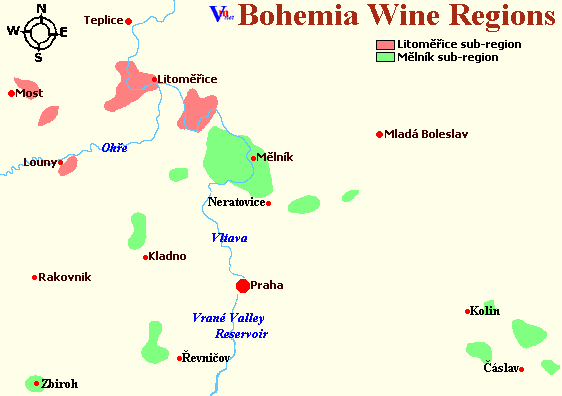
Bohemia Wine Region – Czech Republic
Bohemia is the smaller of the two official wine regions in the Czech Republic, located in the western and central part of the country around Prague and along the Elbe (Labe) River. Although Moravia dominates Czech wine production, Bohemia maintains a historic but limited viticultural presence.
The climate in Bohemia is cooler and more marginal for grape growing compared to Moravia. Vineyards are typically planted on sheltered slopes along river valleys where sunlight exposure and reflected heat support ripening. Production volumes are small and often oriented toward local consumption.
Subregions
Bohemia is officially divided into two subregions:- Melnická (Melník)
- Litomerická (Litomerice)
Grape Varieties and Styles
Bohemian vineyards focus primarily on white grape varieties suited to cool climates, including:- Riesling (Ryzlink rýnský)
- Müller-Thurgau
- Pinot Blanc (Rulandské bílé)
- Pinot Noir (Rulandské modré)
Wines are predominantly dry and light to medium-bodied, with emphasis on acidity and freshness. Sparkling wines are also produced, benefiting from the region's naturally high acidity levels.
Bohemia remains a minor but historically significant component of Czech viticulture, complementing the larger and more diverse Moravian region.