
Beaujolais, France
Go to France's Wine Regions MapBeaujolais - Region Overview (Wine Context)
- Location: Eastern France south of Burgundy and north of Lyon.
- Administrative region: Auvergne-Rhone-Alpes
- Main centre: Villefranche-sur-Saone.
- Total vineyard area: Approximately 16,000 to 17,000 hectares.
- Regional divisions: Beaujolais AOC, Beaujolais Villages, and 10 designated cru villages.
Wine and Viticulture Statistics
- Wine climate: Transitional climate between continental Burgundy and more Mediterranean southern France.
- Crus of Beaujolais: Morgon, Fleurie, Moulin-a-Vent, Brouilly, Cote de Brouilly, Chiroubles, Regnie, Julienas, Saint-Amour, Chenas.
- Main grape variety: Gamay (dominant), with limited Chardonnay plantings.
- Wine styles: Light to medium-bodied red wines, fruit-forward Beaujolais Nouveau, and more structured cru wines capable of ageing.
- Industry notes: Beaujolais remains a historic wine region while administratively part of the larger Auvergne-Rhone-Alpes region.
Map of Beaujolais
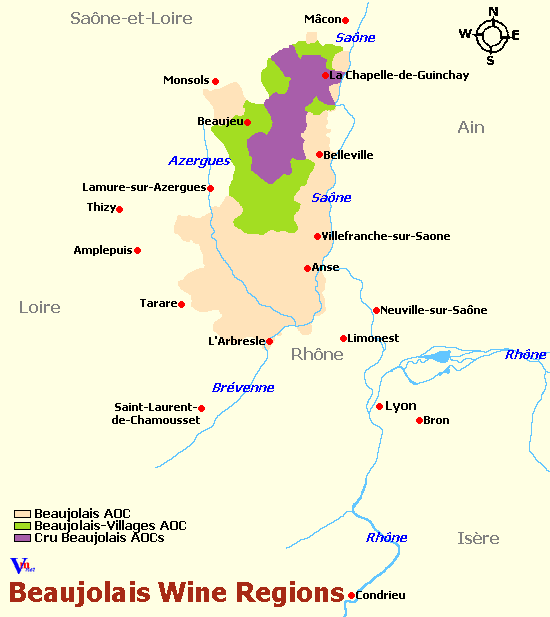
Beaujolais Wine Region
BeaujolaisGo to France's Wine Regions Map
Maps
Africa Asia Europe North America South America Oceania World MapBeaujolais Wine Region - France
Beaujolais is located in eastern France, immediately south of Burgundy and north of Lyon. Although often administratively linked to Burgundy, Beaujolais has a distinct identity shaped by its dominant grape variety and granite-based soils. The region stretches along rolling hills between the Saône River and the Beaujolais mountains.
The climate is transitional, combining continental and Mediterranean influences. Northern Beaujolais tends to have more granite and schist soils, producing structured wines, while the southern sector features more clay and limestone, resulting in lighter styles.
AOC Structure
Beaujolais operates under a three-tier AOC structure:- Beaujolais AOC - Regional designation, generally lighter and fruit-forward wines.
- Beaujolais-Villages AOC - Covers selected communes producing higher-quality wines.
- Cru Beaujolais AOCs - Ten named crus in the northern part of the region:
- Brouilly
- Cote de Brouilly
- Morgon
- Fleurie
- Moulin-a-Vent
- Julienas
- Chiroubles
- Saint-Amour
- Chenas
- Regnie
Grape Varieties and Styles
Beaujolais is overwhelmingly planted to Gamay, which produces bright, fruit-driven red wines with moderate tannins and vibrant acidity. Traditional carbonic or semi-carbonic maceration is commonly used, enhancing fresh fruit aromas.
White wines are produced in smaller quantities from Chardonnay, mainly in the southern part of the region.
Beaujolais is internationally known for Beaujolais Nouveau, released annually in November shortly after harvest. While Nouveau is light and intended for early consumption, the cru wines demonstrate greater depth and aging potential, distinguishing Beaujolais as more than a simple early-release wine region.
Contributed content used with permission.
All Rights Reserved