
Champagne, France
Go to France's Wine Regions MapChampagne - Region Overview (Wine Context)
- Location: Northeastern France east of Paris, centred around Reims and Epernay.
- Administrative region: Grand Est
- Main centres: Reims, Epernay.
- Total vineyard area: Approximately 34,000 hectares.
- Main subregions: Montagne de Reims, Vallee de la Marne, Cote des Blancs, Cote de Sezanne, Aube (Cote des Bar).
Wine and Viticulture Statistics
- Wine climate: Cool continental climate with chalk-rich soils providing drainage and heat retention.
- Main grape varieties: Chardonnay, Pinot Noir, Pinot Meunier.
- Wine styles: Traditional method sparkling wines including non-vintage blends, vintage Champagne, blanc de blancs, blanc de noirs, and rose Champagne.
- Annual production: Approximately 300 million bottles in typical production years.
- Classification system: Appellation dOrigine Controlee (AOC) with village-level historic classifications.
- Industry notes: Champagne remains a historic wine region while administratively part of the Grand Est region of France.
Map of Champagne Wine Region
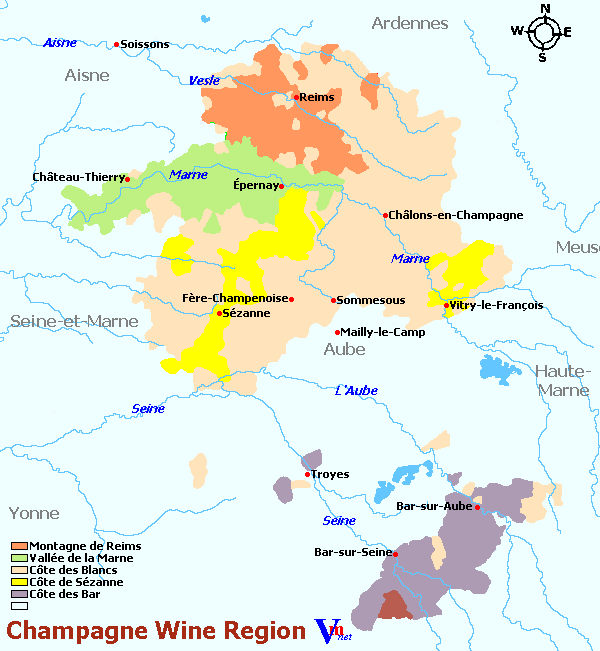
Champagne Wine Region
ChampagneGo to France's Wine Regions Map
Maps
Africa Asia Europe North America South America Oceania World MapChampagne Wine Region - France
Champagne is located in northeastern France, approximately 150 km east of Paris. The region's cool continental climate, chalk-rich soils, and marginal ripening conditions make it uniquely suited to high- acidity base wines ideal for sparkling production. Champagne is internationally protected as a designation of origin under French AOC and EU PDO law.
Vineyards are concentrated around the cities of Reims, Épernay, and Troyes, and are divided into key subregions:- Montagne de Reims - Known primarily for Pinot Noir.
- Vallée de la Marne - Noted for Pinot Meunier.
- Côte des Blancs - Dominated by Chardonnay.
- Côte de Sézanne
- Aube (Côte des Bar) - Warmer southern area with increasing importance.
AOC Structure
Champagne operates under the Champagne AOC, which strictly regulates grape varieties, vineyard practices, yields, blending, aging requirements, and the traditional method (méthode champenoise) of secondary fermentation in bottle.
Vineyards are further classified historically as:- Grand Cru
- Premier Cru
- Other classified villages
Grape Varieties and Styles
Champagne is primarily produced from three grape varieties:- Chardonnay
- Pinot Noir
- Pinot Meunier
- Non-Vintage (NV) blends
- Vintage Champagne
- Blanc de Blancs (100% Chardonnay)
- Blanc de Noirs (Pinot Noir and/or Meunier)
- Rosé Champagne
- Prestige Cuvée
Champagne wines are known for high acidity, fine mousse (bubbles), and aging potential. Extended lees aging contributes to complexity and autolytic character.
Champagne remains one of the most tightly regulated and globally recognized wine regions in the world, setting the benchmark for traditional-method sparkling wine production.
Contributed content used with permission.
All Rights Reserved