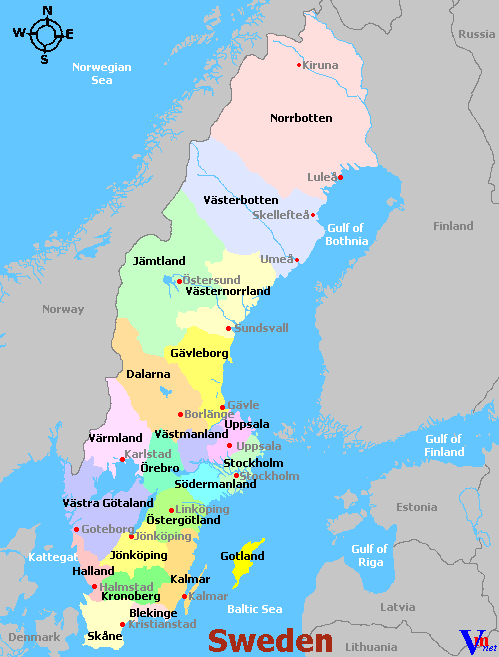
Sweden

Sweden - Country Overview (Wine Context)

  • Location: Northern Europe, on the Scandinavian Peninsula, bordered by Norway and Finland, with coastlines on the Baltic Sea and North Sea.
  • Capital: Stockholm.
  • Area: 450,295 square kilometres (173,860 square miles).
  • Population (2025 est.): About 10.6 million people.

Wine and Viticulture Statistics

  • Wine climate: Cool northern climate with long summer daylight hours and cold winters.
  • Grape viticulture: Limited but expanding, primarily in southern Sweden.
  • Main growing areas: Skane, Halland, and the islands of Gotland and Oland.
  • Typical grape varieties: Cold-hardy hybrids such as Solaris, Rondo, Regent, and limited Pinot Noir.
  • Wine production: Small-scale commercial grape wine production alongside fruit- based wines.
  • Mead (honey wine): Mead has ancient roots in Scandinavian tradition and is produced today by small-scale Swedish makers, often incorporating local berries and botanicals.
  • Cider: Cider is produced in Sweden on both small and commercial scales, using apples and pears from southern growing regions, with still and sparkling styles.
  • Industry notes: Swedens fermented beverage sector combines emerging grape wine production with established traditions of mead, cider, and fruit fermentation.

Wine in Sweden

Sweden is located in Northern Europe on the Scandinavian Peninsula, bordered by Norway, Finland, and the Baltic Sea. Due to its high latitude and cool climate, traditional grape viticulture is limited and relies on careful site selection in the southern regions.

Wine production is small-scale and concentrated mainly in Skane, Gotland, and sheltered coastal areas. Vineyards use cold-hardy and hybrid grape varieties such as Solaris, Rondo, Regent, and Vidal, chosen for early ripening and disease resistance. Wines are typically light, fresh, and produced primarily for domestic consumption.

Alongside grape wine, Sweden has a strong tradition of cider and mead. Cider, often apple-based and increasingly produced in dry and sparkling styles, forms an important part of Sweden's fermented beverage culture. Mead, made from honey, is also produced on an artisanal scale and reflects historical Nordic practices. Wine, cider, and mead production emphasizes adaptation to northern growing conditions and quality-focused small batches.


Copyright © 2009-2019 Wineandvinesearch.com and contributors.
Contributed content used with permission.
All Rights Reserved
Copyright © 2009-2018 Wineandvinesearch.com and contributors.
Contributed content used with permission.
All Rights Reserved