Home
Africa
Asia
Europe
North America
Oceania
South America
Contact Us
Belgium
Go to:
Go to Map of Belgium's Wine Regions
Belgium - Country Overview
Location:
Western Europe, bordered by France, Luxembourg, Germany, and the Netherlands, with a North Sea coastline.
Capital:
Brussels.
Area:
30,689 square kilometres (11,848 square miles).
Population (2025 est.):
About 11.8 million people.
Wine and Viticulture Statistics
Wine climate:
Cool climate influenced by the North Sea and Atlantic weather patterns.
Main wine regions:
Flanders and Wallonia.
Recognised wine-producing provinces:
Flemish Brabant, Limburg, Walloon Brabant, Hainaut, Namur, and Liege.
Vineyard area:
Approximately 900 to 1,000 hectares.
Number of wineries:
Over 300 producers.
Annual wine production:
Around 2 to 3 million litres.
Main white grape varieties:
Chardonnay, Pinot Blanc, Auxerrois, Solaris.
Main red grape varieties:
Pinot Noir, Regent, Dornfelder.
Typical wine styles:
Traditional-method sparkling wines, dry white wines, light-bodied red wines, and rose.
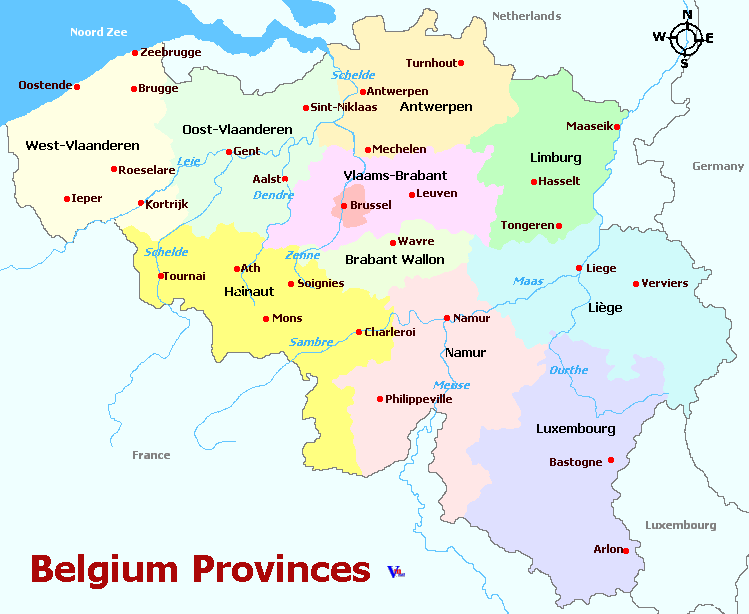
Map of Belgium
Europe
» Europe Union
Belgium
Antwerpen
Brabant Wallon
Brussel
Hainaut
Liege
Limburg
Luxembourg
Namur
Oost-Vlaanderen
Vlaams-Brabant
West-Vlaanderen
»» Map of Belgium Wine Regions
Maps
Africa
Asia
Europe
North America
South America
Oceania
World Map
Privacy Policy
Copyright © 2009- Wineandvinesearch.com and Vmnet.
All Rights Reserved